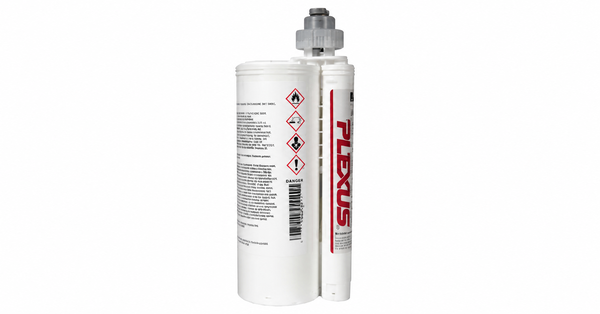
PLEXUS MA420W
Harmonization Code : 3904.61.00.00 | Polytetrafluoroethylene plates / sheets / film / tape / strip, self-adhesive, in rolls
Main features
- Fast 3-4 Minute Assembly
- Rapid 13.5-Minute Strength Build
- Wide 0.25-9.5 mm Gap Range
Product Description
Plexus MA420W is a two-part, 10:1 methacrylate adhesive for rapid structural bonding of thermoplastics, metals, and composites. At 75 deg F (23.9 deg C), it provides a 3-4 minute work time, reaches 500 psi (3.4 MPa) in 13 minutes, and reaches 1,000 psi (6.9 MPa) in 13.5 minutes. The non-sagging system fills gaps from 0.25 to 9.5 mm. Typical cured properties include 18.0-22.0 MPa tensile strength, 20-40% elongation, 75 Shore D hardness, and 25.0 MPa lap shear on aluminum.
Key features
- 3-4 Minute Work Window: Supports rapid assembly at 75 deg F (23.9 deg C).
- 13.5-Minute 1,000 psi Build: Develops 6.9 MPa shear strength quickly at 75 deg F.
- 0.25-9.5 mm Gap Tolerance: Accommodates thin and thick structural joints.
Applications
Applications include rapid structural bonding of thermoplastics, metals, and composites, including transportation composite assemblies.
TDS, SDS & Technical Documents
Technical Specifications
General Properties
Additional Information
Structural Adhesive
Plexus® MA420W rapid-curing structural adhesive
Plexus® MA420W is a two-part methacrylate structural adhesive for thermoplastic, metal, and composite assemblies. The 10:1 by-volume system dispenses as a non-sagging gel and provides a typical 3-4 minute work time at 75 F (23.9 C). It is supplied for cartridge or bulk dispensing and supports joint gaps from 0.010 to 0.375 in (0.25 to 9.5 mm).
As supplied
Typical uncured component properties
Part A and Part B values are shown separately from mixed-system processing and cured-property data.
| Property | Part A | Part B | Method / condition |
|---|---|---|---|
| Color | Off-white | Blue / Black | Typical uncured property |
| Mix ratio by volume | 10 | 1 | System ratio |
| Mix ratio by weight | 8.80 | 1.00 | System ratio |
| Component density | 0.94 g/mL | 1.05 / 1.07 g/mL | Typical uncured property |
| Component viscosity | 80-100 x 1000 cP | 50-80 x 1000 cP | Test temperature not stated |
Values are typical. The component-viscosity row does not state a test temperature.
Processing
Mix, dispense, mate, and fixture within the working window
MA420W can be applied from ready-to-use cartridges or automatic meter/mix/dispense equipment. Application temperature affects component viscosity and cure rate.
Application sequence
- Use enough adhesive to fill the joint completely when the parts are mated.
- For cartridge application, load the cartridge, remove the end caps, attach the mixing tip, and purge approximately one mixer length.
- Apply the adhesive and mate the parts within the specified work time.
- Fix the assembly in position until sufficient bond strength is reached.
Recommended application temperature: 65-85 F (18-30 C). Temperatures outside this range can materially change cure rate.
Typical strength-development profile
| Temperature | Work time | Time to 50 psi | Time to 500 psi | Time to 1000 psi |
|---|---|---|---|---|
| 60 F (15.6 C) | 5-6 min | 15.5 min | 18.5 min | 20 min |
| 75 F (23.9 C) | 3-4 min | 10.5 min | 13 min | 13.5 min |
| 90 F (32.2 C) | 2-3 min | 9 min | 9.5 min | 10.5 min |
Strength thresholds are not the same as full cure. Surface mating must occur within the applicable work time.
Storage and handling
Storage conditions and shelf life
Shelf life: 10 months, or 7 months in Black, based on continuous storage between 55 F and 77 F (13-25 C). Exposure above 80 F (27 C) reduces shelf life, and exposure above 100 F (38 C) should be avoided.
Cool storage between 45 F and 65 F (7-18 C) may extend shelf life. If stored cold, allow the product to return to room temperature before use. Keep material temperature reasonably consistent to support consistent dispensing of adhesive and activator.
Technical guidance
Match surface preparation to the substrate condition
For optimal performance, bonding surfaces should be free of grease, dirt, and other contaminants. The required preparation depends on the substrate and the degree of contamination.
Plastics and coated metals
A dry wipe or light solvent cleaning may be sufficient. Validate the actual surface condition and preparation method for the intended joint.
Raw metals
Oxidation, scale, fluids, and other contaminants can affect bonding. A dry wipe or light solvent cleaning may be sufficient, while the lap-shear dataset recommends PC120 Cleaner Conditioner on metal.
Composites
Dust-free composite surfaces can be bonded as-is or may require light abrasion to remove mold release or increase surface area.
Cured system
Typical cured properties
These values apply to the mixed and cured MA420W system, not to either component by itself.
| Property | Typical value | Method / condition |
|---|---|---|
| Peak exotherm time, 10 g | 6-9 min | 10 g sample |
| Peak exotherm temperature, 10 g | ~250 F (~120 C) | 10 g sample |
| Gap tolerance | 0.010-0.375 in (0.25-9.5 mm) | System gap range |
| Hardness | Shore D 75 | Typical cured property |
| Tensile strength | 2,610-3,190 psi (18.0-22.0 MPa) | ASTM D638 / ISO 527 |
| Tensile modulus | 170-230 kpsi (1,172-1,586 MPa) | ASTM D638 / ISO 527 |
| Elongation at break | 20-40% | ASTM D638 / ISO 527 |
Typical values are not production specifications.
Performance evidence
Typical lap-shear results by substrate
Lap-shear results are substrate- and preparation-specific. Use the values below only within the stated ASTM D1002 test context.
| Substrate | Typical lap shear | Failure mode | Method / condition |
|---|---|---|---|
| Aluminum | 3,622 psi (25.0 MPa) | AF - adhesive failure | ASTM D1002; PC120 recommended on metal |
| PU composite | 676 psi (4.7 MPa) | SF - substrate failure | ASTM D1002 |
| Painted steel | 1,372 psi (9.5 MPa) | CP - coating pull | ASTM D1002; PC120 recommended on metal |
| DCPD | 1,400 psi (9.7 MPa) | SF - substrate failure | ASTM D1002 |
| Metton | 1,125 psi (7.8 MPa) | SF - substrate failure | ASTM D1002 |
Failure-mode abbreviations shown here are limited to the modes present in this dataset: AF = adhesive failure; CP = coating pull; SF = substrate failure.
Applications
Structural bonding across supported assembly materials
MA420W is intended for structural bonding of thermoplastic, metal, and composite assemblies. Evaluate the actual substrate, surface condition, joint design, and process before qualification.
Thermoplastic assemblies
Structural bonding where the specific thermoplastic and surface condition are validated for the intended joint.
Metal assemblies
Structural bonding of supported metal assemblies with preparation selected for contamination, oxidation, coating, and other surface conditions.
Composite assemblies
Composite bonding applications, including transportation assemblies, with surface preparation selected for the actual composite and mold-release condition.
Technical support for Plexus® MA420W
Need help evaluating Plexus MA420W for a specific substrate pair, joint gap, dispensing format, or production temperature? Krayden can help review surface preparation, application conditions, and the documented MA420W processing window so trials are planned around the actual assembly and required test configuration.